Theorem:
If is a matrix group and is its Lie algebra then there are neighbourhoods of the zero matrix and of the identity such that and is invertible.
The exponential map is not invertible, but we have seen that there are neighbourhoods of the zero-matrix and of the identity matrix such that and is invertible, with inverse .
We can think of this as providing for us coordinates near , namely gives a parametrisation of , so we can think of the matrix entries as coordinates on : anything in can be written in this form for a unique collection of numbers .
We could like the same to work for any matrix group . Namely, we would like to show:
If is a matrix group and is its Lie algebra then there are neighbourhoods of the zero matrix and of the identity such that and is invertible.
Let and . First, we note that does indeed go from to by definition of , and , so .
So what is left to prove? The map is invertible, hence injective, so its restriction must also be injective. But is surjective? In other words, is it clear that ?
This figure shows what you might imagine going wrong (we will later show that this doesn't happen, at least if you shrink and ). It shows a cartoon of a subgroup which "wraps back on itself" and gets very close to the identity but never quite gets there. You can now imagine that when you intersect with a very small (in red), (in blue) could end up missing this appendage of which wraps back towards the identity (in green), because to get to this appendage you have to exponentiate something very large. In other words, is the blue bit and is everything which is blue or green. In the end, we will show this doesn't happen, so this is a cartoon picture of something which doesn't happen. You therefore shouldn't be too annoyed if the picture doesn't make sense.
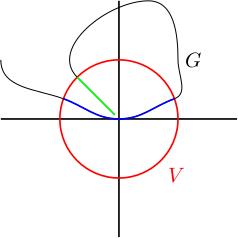
If surjectivity of fails then there's an element such that . We could try to fix this by shrinking and , but let's suppose that doesn't help us. This will mean there is a sequence such that and for all (you should imagine a sequence of matrices on the green appendage, tending to the origin in the picture).
Let's assume that there is such a sequence and aim to derive a contradiction.
Recall that is a subspace. Pick a vector space complement for , that is and . In the figure, is supposed to be the horizontal axis (tangent to at the identity) and is supposed to be the vertical axis.
I claim that the map defined by is locally invertible like , i.e. there exists a neighbourhood of and a neighbourhood of such that and is invertible. This is proved using the inverse function theorem, just like for (compute the derivative of at the zero map and show this derivative is invertible). I leave it as an exercise to fill in the details.
Therefore, if is sufficiently close to the identity (which it is for large ), then for some sequence and .
Our sequence is not in , so for all . In particular, we can divide by its matrix norm to get a matrix with norm 1. Since the set of matrices with norm 1 is closed and bounded (compact), the sequence converges to some matrix with norm 1 (in particular, ).
We are going to prove that ; this will give us a contradiction, as and is a complement for . For this, we need to show that for all .
Fix . Consider and take its integer and fractional parts , , . Since as , we know that , so , hence (as is fixed) and hence .
We want to show that . First note that for all because and and are both in . Because is a group, and because commutes with itself. The sequence converges to because and .
Because is topologically closed, this limit lives in , so . This argument works for every , so we're done.
The outcome of all this is that, via the exponential map, local coordinates on
near the zero matrix give us local coordinates on
near the identity. We call this an