Lemma:
If is a representation and (this is not necessarily the in ) we have In other words, we use the "Leibniz/product rule".
So far we have seen that, given a complex representation , we get:
a (real linear) representation of the real Lie algebra
a (complex linear) representation of its complexification .
Define the basis , and of . We saw that where and saw that and act on weight spaces as follows:
takes vectors in to vectors in ,
takes vectors in to vectors in .
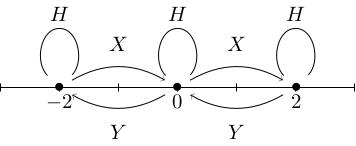
We will usually omit the superscript from and actually, we'll usually omit the altogether.
In this video, I want to see how this actually works in practice for the example . But first, we will need to understand how Lie algebras act on symmetric powers and, more generally, tensor products.
Recall that . What is the Lie algebra representation corresponding to this? In other words, what is ?
If is a representation and (this is not necessarily the in ) we have In other words, we use the "Leibniz/product rule".
For now, we will assume this lemma, work out the example and then justify the lemma.
Let . If and form a basis for then , and form a basis for . The Lie algebra elements , and act on and as follows:
Since , we have , ,
Since , we have , ,
Since , we have , .
therefore sends to by the product rule. Similarly, and The weight spaces, that is the eigenspaces of , are spanned by (weight 2), (weight 0) and (weight ).
Let's compute :
Notice that in this last example we used the fact that (which holds because it's a symmetric tensor).
In terms of our weight diagram, we can see that is taking to (increasing the weight by 2) and to (again, increasing the weight by 2). Finally, it takes to (necessarily, since ).
It's an exercise to calculate .
We still need to prove that can be evaluated using the Leibniz rule, as stated in the lemma.
We have by our usual formula for Lie algebra representations.
Let's apply both sides to and expand both sides in powers of . The right-hand side is The left-hand side is
We have , so multiplying out the brackets, the left-hand side becomes:
By comparing the terms of order , we get the desired formula for .
Compute the action of on the basis , , .