Definition:
Given a matrix group with Lie algebra , the adjoint representation is the homomorphism defined by In other words:
-
the vector space on which we're acting is ,
-
is a linear map .
Before we classify the representations of , I want to introduce a representation which makes sense for any Lie group, the adjoint representation, and study it for .
Given a matrix group with Lie algebra , the adjoint representation is the homomorphism defined by In other words:
the vector space on which we're acting is ,
is a linear map .
It is an exercise to check that this is a representation, but I will explain why it is well-defined, in other words why is when and .
If and then .
We need to show that for all , . As a power series, this is:
All of the s sandwiched between the s cancel and we get
Since , and for all , we see that this product is in for all , which proves the lemma.
The induced map on Lie algebras is . (I apologise for the profusion of g's playing different notational roles).
Let's calculate for some . This is a linear map , so let's apply it to some : (This is how we calculate for any representation : it follows by differentiating with respect to ). This gives:
In other words, Note that this makes sense even without reference to .
Since we know already that it's a representation of Lie algebras, but it's possible to prove it directly from the axioms of a Lie algebra without reference to the group i.e. that for all . Do this!
Recall that we have a basis for . Let's compute with respect to this basis.
sends:
to ,
to ,
to ,
so with respect to this basis.
In fact, the action of on a representation tells us the weights, so we see that the weights of the adjoint representation are . In particular, the adjoint representation is isomorphic to .
It's an exercise to compute and .
Let's find a basis of . Define to be the matrix with zeros everywhere except in position where there is a 1, e.g. There are 6 such matrices with . Together with this gives us a basis of ; in other words, any tracefree complex matrix can be written as a complex linear combination of these 8 (it's an 8-dimensional Lie algebra).
More generally, we will write where is a vector satisfying I want to compute .
We have because the -matrices are all diagonal (and hence all commute with one another). This means that and are contained in the zero-weight space of the adjoint representation. This is because , so the eigenvalues of tell us the weights of the representation.
It turns out that . For example:
Let's figure out the weights of the adjoint representation. If then we have , so . For example, satisies , so .
Similarly, we get , so .
The other weight space that occur are: and the weight diagram is the hexagon shown in the figure below.
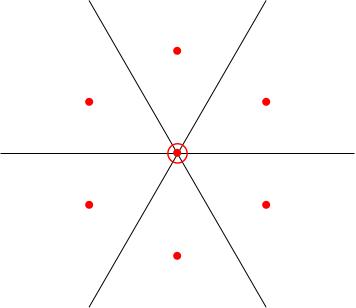
Note that the zero-weight space is spanned by and , which means it's 2-dimensional. We've denoted this by putting a circle around the dot at the origin in the weight diagram.
The weight space decomposition of the adjoint representation is sufficiently important to warrant its own name: it's called the root space decomposition. The weights that occur are called roots and the weight diagram is called a root diagram.
The matrices inhabit the following weight spaces: and the weight diagram is the hexagon shown above.