Duals

Definition

Definition:

Given a representation R : G → G ⁢ L ⁢ ( V ) , the dual representation R * : G → G ⁢ L ⁢ ( V * ) is defined as follows.

  • The dual vector space V * is the space hom ⁢ ( V , 𝐂 ) of linear maps from V to 𝐂 . Equivalently, if we think of V as a space of column vectors by picking a basis of V then we can think of V * as the space of row vectors: given an element α ∈ hom ⁢ ( V , 𝐂 ) , we get a row vector α ¯ as follows. Pick a basis of V so that elements can be written as column vectors v = ( v 1 ⋮ v n ) . Then α ⁢ ( v ) = α 1 ⁢ v 1 + ⋯ + α n ⁢ v n for some coefficients α i . Define α ¯ = ( α 1 ⋯ α n ) (so α ⁢ ( v ) = α ¯ ⋅ v ).

    Conversely, if you have a row vector w = ( w 1 ⋯ w n ) then we get the linear map w ¯ ∈ hom ⁢ ( V , 𝐂 ) , defined by w ¯ ⁢ ( v ) = w 1 ⁢ v 1 + ⋯ + w n ⁢ v n .

  • The dual representation is defined as follows. For each g ∈ G , define R * ⁢ ( g ) : V * → V * to be the map which sends a row vector α ¯ to α ¯ ⁢ R ⁢ ( g ) - 1 . In other words, R * ⁢ ( g ) ⁢ α ¯ = α ¯ ⁢ R ⁢ ( g ) - 1 .

    The messing with underlines is just to distinguish between applying a linear map and multiplying a matrix, because we want to multiply on the right.
Lemma:

This defines a representation.

Proof:

We have R * ⁢ ( g 1 ⁢ g 2 ) ⁢ α ¯ = α ¯ ⁢ R ⁢ ( g 1 ⁢ g 2 ) - 1 = α ¯ ⁢ R ⁢ ( g 2 ) - 1 ⁢ R ⁢ ( g 1 ) - 1 . But α ¯ ⁢ R ⁢ ( g 2 ) - 1 = R * ⁢ ( g 2 ) ⁢ α ¯ , and so α ¯ ⁢ R ⁢ ( g 2 ) - 1 ⁢ R ⁢ ( g 1 ) - 1 = R * ⁢ ( g 1 ) ⁢ R * ⁢ ( g 2 ) ⁢ α ¯ . Therefore R * ⁢ ( g 1 ⁢ g 2 ) = R * ⁢ ( g 1 ) ⁢ R * ⁢ ( g 2 ) as required.

Examples

SU(2) representations

Lemma:

If R : S ⁢ U ⁢ ( 2 ) → G ⁢ L ⁢ ( V ) is a complex representation with a given weight diagram D then R * has the weight diagram D * = D .

Remark:

We will prove that the weights of D * are given by minus the weights of D . Since weight diagrams of S ⁢ U ⁢ ( 2 ) representations are symmetric about the origin, this means D = D * . By our classification theorem for S ⁢ U ⁢ ( 2 ) representations, we deduce that R ≅ R * for any S ⁢ U ⁢ ( 2 ) -representation.

Proof:

Let W n be the weight space with weight n . Recall that v ∈ W n then R ⁢ ( e i ⁢ θ 0 0 e - i ⁢ θ ) ⁢ v = e i ⁢ n ⁢ θ ⁢ v . If we apply † (conjugate transpose) to both sides of the equation, we get: v † ⁢ R ⁢ ( e i ⁢ θ 0 0 e - i ⁢ θ ) † = e - i ⁢ n ⁢ θ ⁢ v † .

Now v † is the row vector ( v ¯ 1 ⋯ v ¯ k ) .

We have an invariant Hermitian inner product on our representation. If we pick a basis which is orthonormal with respect to that then the matrices R ⁢ ( e i ⁢ θ 0 0 e - i ⁢ θ ) of our representation (with respect to this basis) will be unitary, that is R ⁢ ( e i ⁢ θ 0 0 e - i ⁢ θ ) † = R ⁢ ( e i ⁢ θ 0 0 e i ⁢ θ ) - 1 . In other words, this is the matrix which, when acting on the right on row vectors, defines R * ⁢ ( e i ⁢ θ 0 0 e - i ⁢ θ ) .

This tells us that v † ∈ V * is a weight vector of R * with weight - n , so the weights of R * are minus the weights of R . Since the weights of R are symmetric around the origin, this implies D = D * and R * ≅ R .

SU(3) representations

For S ⁢ U ⁢ ( 3 ) , the same argument tells us that the weights of R * are minus the weights of R .

Example:

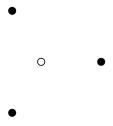
If V is the standard representation then its weight diagram is

Weight diagram of standard rep of SU(3): vertices at L_1, L_2, L_3

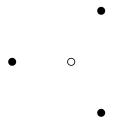
so its dual has the following weight diagram:

Weight diagram of the dual of the standard rep of SU(3): vertices at minus L_1, minus L_2, minus L_3

Since these diagrams are different, V is not isomorphic to V * .

Mesons

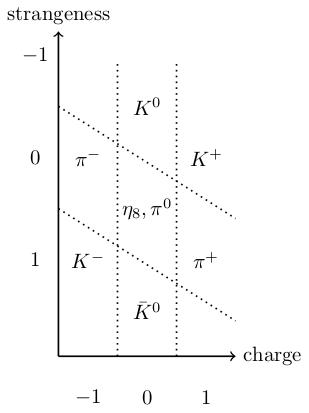
The quark model we discussed earlier can be extended to allow both quarks and antiquarks: antiquarks live in the dual of the standard representation. A meson is then a particle obtained by combining one quark and one antiquark, so lives in 𝐂 3 ⊗ ( 𝐂 3 ) * . It's an exercise to see that this decomposes as Γ 1 , 1 ⊕ 𝐂 . This corresponds to the classification of mesons:

Hexagonal table of mesons

There are 8 particles in an octet (shown) and one particle ( η 1 ) in a singlet (with both strangeness and charge zero).

Pre-class exercise

Exercise:

Find the weight diagram of 𝐂 3 ⊗ ( 𝐂 3 ) * and verify that it decomposes as Γ 1 , 1 ⊕ 𝐂 as claimed.